What does it look like for the pattern of life in a community to move according to a rhythm of growth? What forms can a cycle of expansion, consolidation, reflection, and planning take across a cluster of diverse communities? In the Boston area, the Area Teaching Committee recently set out to investigate these questions. In the ensuing expansion phase — which was driven by a strategy that included in-person gatherings and trainings, a Feast letter from the Area Teaching Committee, digital communications and more — more than seventy home visits took place. Friends and families went on walks, had coffee and shared meals together, read prayers, and performed acts of service, all in a spirit of fellowship and mutual support.
Background
At the national institutional gathering that took place in Pensacola, Florida, in January 2026, much of the consultations focused on the description of a cluster that has passed the third milestone of growth, as laid out in the third paragraph of a recent message from the Universal House of Justice. “Crucially,” the House of Justice writes, “in these clusters, consistent attention is being given to sustaining effective cycles, so that there is a regular pulse of study, consultation, action, and reflection through which the community enhances its capacity to grow and to contribute to the advancement of the society to which it belongs.” In breakout discussions among the group of friends from the Boston area who were attending the gathering, it became clear that, at least at the level of the whole cluster, there was relatively little experience in making plans and taking action in a regular, cyclical pattern. In particular, the description of cycles including “periods of particular intensity, an injection of energy that is propelling the engagement of the widest possible circle of friends” felt like an important area of growth for the Boston community.
The third milestone is a measurement of a journey whose beginnings are well understood. Once it is passed, clusters where progress has been consolidated can be seen to share important features. The institute’s programmes are being supported by a relatively substantial and expanding pool of human resources. Effort is being made to enable more neighbourhoods and villages to sustain intense activity. There is a capacity to embrace large numbers and manage increasing complexity through both formal and informal arrangements. Crucially, in these clusters, consistent attention is being given to sustaining effective cycles, so that there is a regular pulse of study, consultation, action, and reflection through which the community enhances its capacity to grow and to contribute to the advancement of the society to which it belongs. These cycles include periods of particular intensity, an injection of energy that is propelling the engagement of the widest possible circle of friends. Community undertakings such as family festivals, junior youth camps, service projects, arts endeavours, and collective teaching initiatives are proceeding according to their own respective rhythms. Reflection spaces bring together many friends, and the use of such spaces is thoughtful and deliberate—there is awareness that the quality and utility of reflection is measured by the purposeful action arising from it. From these clusters, resources flow to surrounding clusters to help the friends there make accelerated progress.
The Universal House of Justice (31 December 2025 — To the Conference of the Continental Boards of Counsellors)
Early in the summer following the national gathering, the regional growth facilitator in the Northeast met with the secretary of Boston’s Area Teaching Committee and the Auxiliary Board member in the area to discuss how to carry out a truly clusterwide expansion phase. The group set a date for mid-September, hoping to capitalize on the energy of people returning to school and coming back from summer travels, and decided to focus on home visits as a strategy to build friendships and have conversations across the cluster.
Preparing for the Expansion Phase
The expansion phase, often a period of two weeks, demands the highest level of intensity. Its objective is to widen the circle of those interested in the Faith, to find receptive souls and to teach them. Although this phase might include some element of proclamation, it should not be seen as a time to hold a few events for this purpose or to undertake a set of activities that merely convey information. Experience suggests that the more closely teaching approaches and methods are aligned with the capacity acquired from the study of the institute courses the more rewarding the results.
The Universal House of Justice (27 December 2005 – To the Conference of the Continental Boards of Counsellors)
With this timeline in mind, the Area Teaching Committee developed a multi-pronged strategy to build awareness and encourage greater participation in the expansion phase. The strategy included six approaches: the upcoming cluster reflection gathering, an online sign-up form, digital communications, a letter from the Area Teaching Committee to be read at Feast, an online kick-off gathering, and an in-person workshop.
Cluster Reflection Gathering — During the planning portion of the gathering, which was held a month and a half before the new expansion phase dates, the Auxiliary Board member led a discussion on the significance of home visits followed by an announcement of the campaign. A sign-up sheet was passed around for participants to indicate if they were interested to visit others as part of the campaign, be visited, or both and record the names in each category.
Google sign-up form and spreadsheet for Area Teaching Committee — After the reflection gathering, the Area Teaching Committee sent out a summary email that included a link to a Google form for people to sign up to visit others in their homes, or to be visited in their homes. This list was combined with the list that was generated at the cluster reflection gathering.
Emails, newsletter, and text announcements — The Area Teaching Committee also employed several forms of digital communication to raise awareness about the upcoming expansion phase and encourage participation, including emails, a digital flyer that was shared over WhatsApp in various community groups, and including an announcement in Boston’s digital newsletter.
Feast letter — The Area Teaching Committee wrote a letter to be shared at the next Feast, which it sent to Spiritual Assemblies in the cluster about two Feasts before the expansion phase.
Zoom kick-off — The Area Teaching Committee organized a kick off gathering held online, inviting those who had said they were interested in doing visits to attend.
In-person workshop — Lastly, an in-person workshop was held on the first weekend of the expansion phase in order to provide a space to study some guidance and practice having conversations when visiting friends at home. The gathering included time spent visiting friends, and after the visits, participants shared their stories on a specially created WhatsApp group for the campaign, providing encouragement and helpful advice for others who wanted to plan visits.
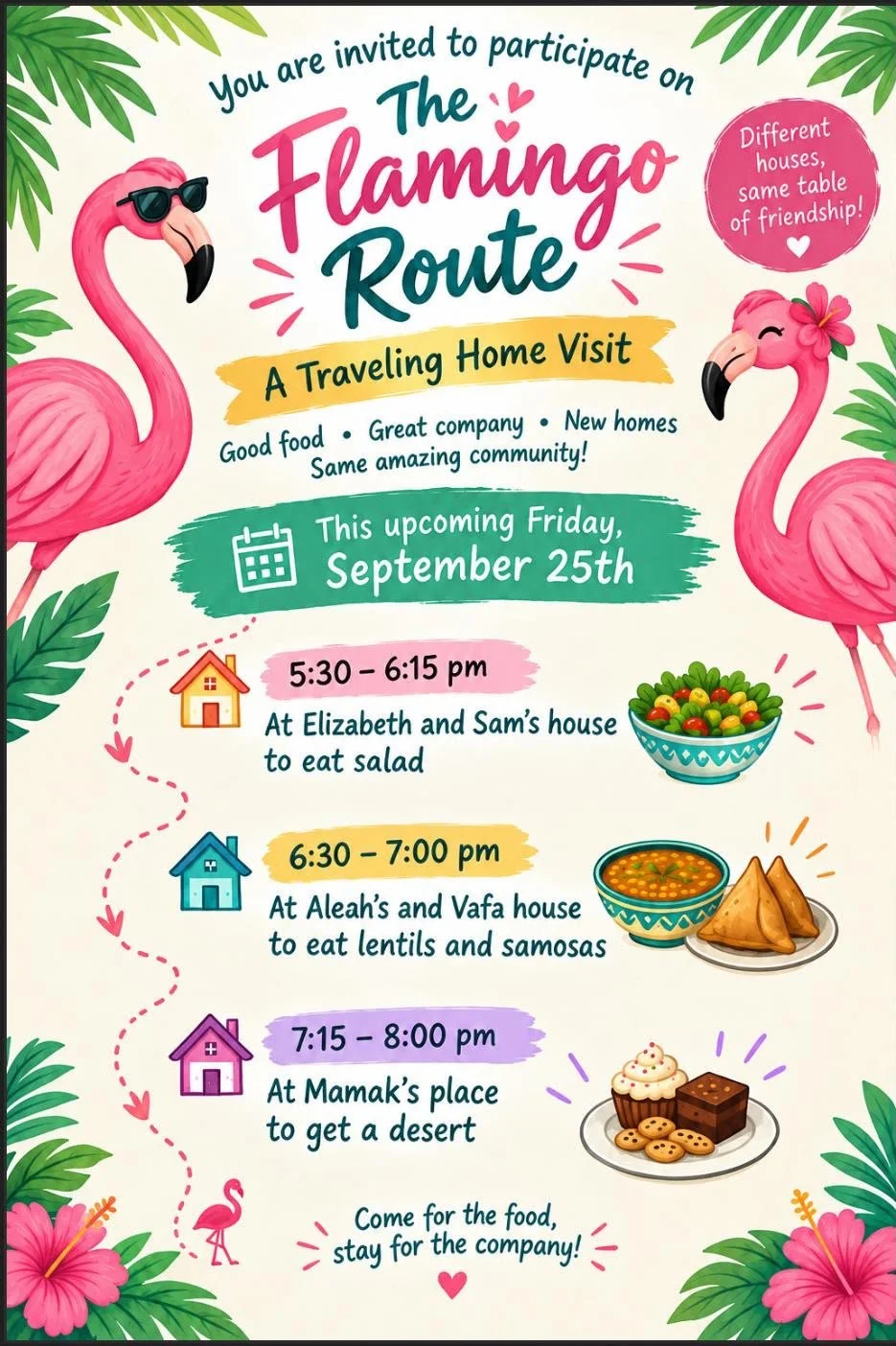
One of the flyers created to promote the expansion phase.
Outcomes of the efforts so far
Because of these efforts, the Area Teaching Committee has noticed a broader participation, and a greater feel of collective action across the whole cluster, in this expansion phase than in the past. While the campaign is not complete and a final reflection still remains to be done, there have already been at least seventy-four visits tallied.
The most effective approaches for communicating about the expansion phase and spurring action have been in-person gatherings such as the cluster reflection gathering, time set aside during the administrative portion of Feast to discuss the Area Teaching Committee’s letter, and the in-person workshop. Digital forms of communication may have raised awareness, but they did not seem to encourage individuals outside of members of cluster agencies to participate. A significant difference between this campaign and the previous one has been the support of the Auxiliary Board members, each of whom live in neighborhoods in the cluster where many activities and strong community networks exist. Their involvement has contributed directly to a greater participation from friends and families that live in those neighborhoods, as well as visits from friends in other neighborhoods.
A word of caution: phrases like “home visit” must not restrict our vision of what is possible, nor should we reduce them to a mere social call. What is really meant is a simple act of love and connection: to visit with someone in an intimate place, check in with them, and create space for “an opportunity to enter into a deep conversation on spiritual matters,” as one passage from the House of Justice describes it. Such a visit can take many forms, as they did during Boston’s expansion phase.
For example, on one visit, families would go to one house for part of a meal and then walk or ride in their car to the next house, which they described as a “traveling devotional.” One of the junior youth who participated shared that “it was very welcoming!”
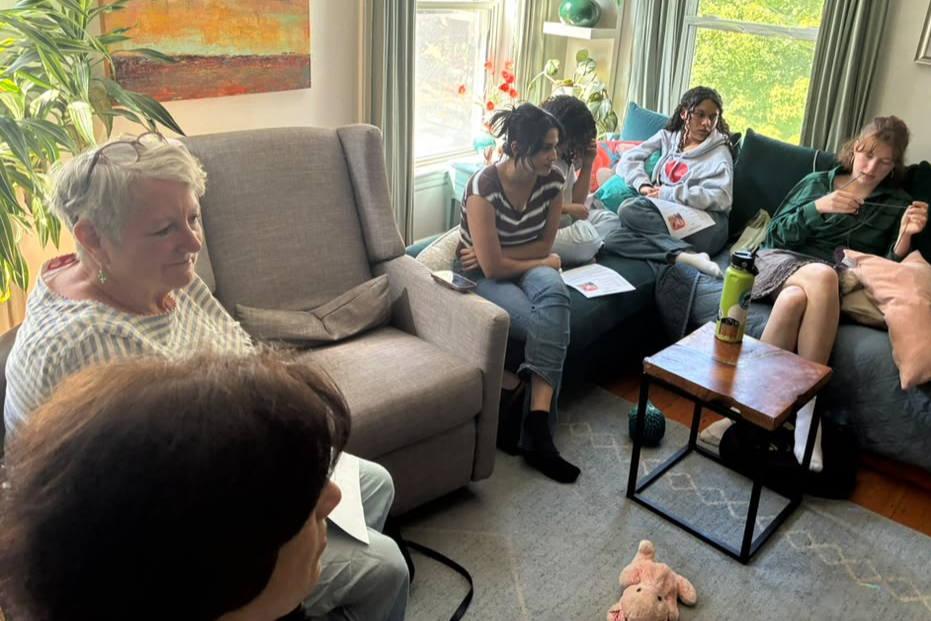
And on another visit, one participant described how teachers of a children’s class visited some of the families of the children, sharing what the kids were learning about in the class and exchanging ideas about how to make the class environment more exciting and interesting. The visit ended with the children leading songs and prayers that they had learned in the class. After the visit, one of the teachers, a youth, said, “I really liked this. I want you all to meet my mom and visit with her.”
For another friend, the conversation circled around points of unity between the different revelations of God. Before visiting the grandmother of two of the children in their children’s class, they went to their nearby community garden and picked some vegetables to bring as a gift. At the grandmother’s home, they watched some of the film The Passion of the Christ together in Spanish. The participant shared,
With my little bit of Spanish, her little bit of English, and some Google Translate — and lots of love for one another — we were able to have a meaningful conversation about the transformative effect that the Gospel has had on the entire world. Then I asked if we could say a prayer for her grandson who just had an accident. She quickly brought out her Bahá’í prayer book and read two prayers in Spanish for him. I then read a Bible-inspired passage that she had sent me earlier that day. She cooked some delicious Dominican rice for us and made salad with the veggies I had brought for her. She then gave a care package to take to a family member who was expecting a baby soon.
Another participant visited relatives who are struggling with chronic illnesses. During the visit, they went to a doctor’s appointment together, helped with chores around the house, and then enjoyed a meal of takeout sandwiches back at home. The participant reflected, “We came back, set the table, shared grace before the meal … because lunch was delicious, we had elevated conversation, and laughs around the table. Despite the fact that infirmity is their reality now, there was an unmistakable feeling of joy that we experienced together around that lunch table. It did my heart good.”